Class Name: Connected Feature Edge
Definition
The one-directional topological relationship between a
Feature Node and the ordered collection of
Feature Edges that are connected to it.
Primary Page in DRM Diagram:
Example
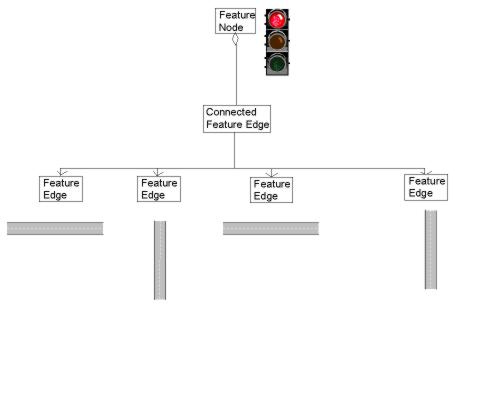
- A Feature Node that represents a four-way
road intersection would have a Connected
Feature Edge component, which would be associated with each of the four
Feature Edges that represent the road segments
that meet at the intersection. Note that the
Feature Node would also be associated
with either the Feature Edge Starting
Node or the Feature Edge Ending
Node component(s) of each of those four Feature
Edges.
FAQs
- When is a Connected Feature Edge
object required?
- A Feature Node object is required to have a
Connected Feature Edge component
whenever it is the endpoint of one or more Feature
Edges. This requirement holds at all feature topology levels. Also, if
a Feature Node is not the endpoint of any
Feature Edge, it must not have a
Connected Feature Edge component.
- Why would a Feature Node have more than
one Connected Feature Edge
component?
- At feature topology levels 0 through 3, all of the
Feature Edges connected to a
Feature Node are located in the same
topological surface; consequently, they can be ordered around the
Feature Node. However, at feature topology level
4, Feature Edges can connect to a
Feature Node from any direction in 3-dimensional
space. When the Feature Edges connected to a
Feature Node are not all located in the same
topological surface, the Feature Edges must be
organized into subsets, one for each separate topological surface, and the
Feature Node must have a separate
Connected Feature Edge component for
each such subset.
- Can the same Feature Edge appear more than
once in the collection of Feature Edges
associated with a Connected Feature
Edge?
- Yes. If a Feature Edge forms a loop, so that
its Feature Edge Starting Node and
its Feature Edge Ending Node are the
same Feature Node, that
Feature Edge will appear exactly twice in the
collection of Feature Edges associated with the
Connected Feature Edge.
- What is the relationship between the
Connected Feature Edge class and the
Feature Edge Terminal Node classes?
- The Connected Feature Edge class
and the Feature Edge Terminal Node
classes (Feature Edge Starting
Node and Feature Edge Ending
Node) form the two halves of the bidirectional topological relationship
between Feature Nodes and
Feature Edges. Whenever a
Feature Edge appears in the
collection of associated with a
Connected Feature Edge component of a
Feature Node, that same
Feature Node must be associated with either the
Feature Edge Starting Node, or the
Feature Edge Ending Node component
of that Feature Edge, and vice versa.
Constraints
Associated to (one-way)
Component of (one-way)
Prev: Conformal Behavior.
Next: Connected Geometry Edge.
Up:Index.