Abstract Class Name: Base Classification Data
Subclasses
Definition
An object containing an alphanumeric code used to classify its parent object
according to the nature of the real-world entity that it represents. This
code is defined by the Environmental Data Coding Standard (EDCS).
Primary Page in DRM Diagram:
Example
- An EDCS Classification Code (ECC) such as
EDCS_CC_DRIVE_IN_THEATER or
EDCS_CC_ROAD.
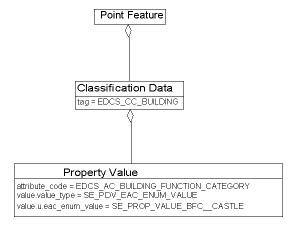
- A Classification Data with
tag =
EDCS_CC_BUILDING, elaborated
with a Property Value component with attribute
code
EDCS_AC_BUILDING_FUNCTION_CATEGORY and value
SE_PROP_VAL_BFC__CASTLE:
FAQs
- What does Base Classification
Data classify?
- Let X be a SEDRIS object that contains a subclass object of
Base Classification Data as a
component. The subclass instance specifies what X represents in the
world.
- Why do Base Classification
Data have an optional Property Value
component?
- Some ECC codes are too broad and need elaboration (see example 2).
- Why not just attach an elaborating Property
Value component to the classified object?
- Because that would obfuscate the purpose of the provided value.
- Are there restrictions on which Property
Value instances can be used for components?
- Only Property Values with EACs that are
marked as "Classification related" may be used. In addition,
only those that refine the descriptive quality of the ECC in
its context should be used.
- Where can I find a list of EDCS' classification codes?
- See the EDCS Classification Codes page and Part 4, Volume 10 of the
Documentation Set: Classification, Attribute, and State Coding
Standard.
- How can I find out what version of the EDCS I am using?
- The Level 0 API has a function that provides this information:
SE_GetTransmittalVersionInformation()
Constraints
Composed of (one-way)
Notes
Fields Notes
Contains an EDCS Classification Code (ECC).
Prev: Axis.
Next: Base Hierarchy Data.
Up:Index.