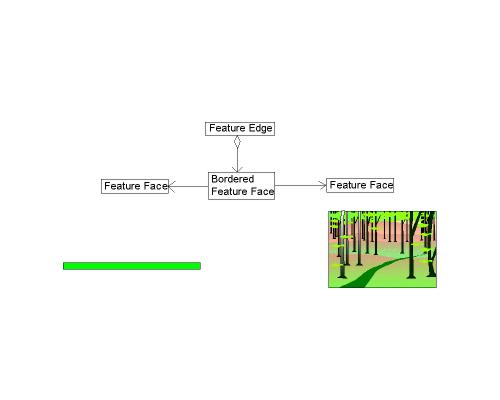
Class Name: Bordered Feature Face
Definition
The one-directional topological relationship between a
Feature Edge and the ordered collection of
Feature Faces that are bordered by it.
Primary Page in DRM Diagram:
Example
- The Feature Edge that forms the boundary
between two Feature Faces, one representing a
field and the other representing a forest, would have a
Bordered Feature Face object
referencing those two Feature Faces. Note that
the Feature Edge would also be referenced by
each of the two Feature Faces via either an
External Feature Face Ring or an
Internal Feature Face Ring.
FAQs
- When is a Bordered Feature Face
object required?
- A Feature Edge object is required to have a
Bordered Feature Face component
whenever it forms part of the boundary of one or more
Feature Faces. At feature topology levels 0, 1,
and 2, Feature Faces will be present only if
they define the shape of an Areal Feature.
Any Feature Edge that forms part of the boundary
of one or more such Feature Faces is required to
have a Bordered Feature Face component.
At feature topology level 3, all Feature Edges
must bound exactly 2 Feature Faces, and so all
Feature Edges must have a
Bordered Feature Face component. At
feature topology level 4, Feature Edges are no
longer required to bound Feature Faces, though
most will, and these Feature Edges must have a
Bordered Feature Face component. If a
Feature Edge does not border any
Feature Faces, it cannot have a
Bordered Feature Face component.
- Can the same Feature Face appear more than
once in the collection of Feature Faces
associated with a Bordered Feature
Face?
- Yes. At feature topology levels 3 or 4, if the
Feature Edge of which the
Bordered Feature Face is a component is
contained within a single Feature Face, that
Feature Face will appear twice is the collection
of Feature Faces associated with the
Bordered Feature Face object.
Furthermore, in such a case, no other Feature
Faces will appear in the collection of Feature
Faces.
- What is the relationship between the
Bordered Feature Face class and the
Feature Face Ring
classes (Internal...) and
External...)?
- The Bordered Feature Face class and
the Feature Face Ring classes form the two
halves of the bidirectional topological relationship between
Feature Edges and
Feature Faces. Whenever a
Feature Face appears in the collection of
Feature Faces associated with the
Bordered Feature Face component of a
Feature Edge, that same
Feature Edge must appear in the collection of
Feature Edges associated with one of the
Feature Face Ring components of that
Feature Face, and vice versa.
Constraints
Associated to (one-way)
Component of (one-way)
Prev: Blend Directional Light.
Next: Bordered Geometry Face.
Up:Index.