Class Name: Primitive Summary Item
Definition
Used to specify common patterns of primitive objects that appear in a
Model or under
Environment Root. Each
Primitive Summary Item represents
an instance, or number of identical instances, of a class
that appears in those parts of the transmittal that follow the pattern.
Primitive Summary Items can only
represent objects of the Primitive
Geometry and Primitive Feature types
and subtypes, and also the types that may come beneath them in the
hierarchy. They are combined together to form a hierarchy that mirrors
the hierarchy of the objects that the
Primitive Summary Items represent.
This summary is actually a compressed form of the real hierarchy, as each
Primitive Summary Item may
represent a number of instances of that object type.
Primitive Summary Item therefore has
a multiplicity field, recording how many of the object type it actually
represents. Note that all instances represented by one
Primitive Summary Item must have
exactly the same hierarchical pattern beneath them, right down to where the
pattern summary finishes. In essence the
Primitive Summary Item
actually represents both the object instance and the specific hierarchy
of objects underneath it.
Primary Page in DRM Diagram:
Secondary Pages in DRM Diagram:
Example
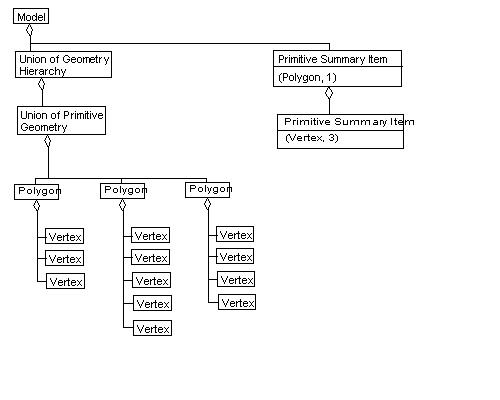
- Summary of a common Polygon structure pattern
within a Model. In this case, the pattern indicates
that we can expect to see triangles. Note that other patterns can be
present; in this particular example, the Model
contains not only triangles, but other types of
Polygons, such as quadrilaterals and even 5-sided
Polygons. The
Primitive Summary Items are
just indicating common patterns; they're not enumerating all
the patterns that are present.
FAQs
- I'm consuming a transmittal in which the
Environment Root's
Primitive Summary Item shows a
Polygon with 3 Vertices and an
Image Mapping Function. Does this mean
that all the terrain Polygons are triangles
with Image Mapping Functions?
- No. It just means that for this particular transmittal that's a
common pattern for terrain Polygons.
- Hey! The examples for SDRM Class
Summary Item show Polygons and
Vertices as SDRM
Class Summary Items, but the examples for
Primitive Summary Item show them as
Primitive Summary Items!
Isn't this ambiguous? What's going on?
- This isn't ambiguous as the two classes
(SDRM Class Summary Item and
Primitive Summary Item summarize
different aspects of a transmittal. Therefore the same classes can (and
will) quite legitimately be represented by both. So
Polygon and Vertex can turn up
as types of SDRM Class Summary Items,
to summarize their presence in the transmittal, and as
Primitive Summary Items, to show
common patterns of objects in which they are used.
Constraints
Composed of (two-way)
Composed of (two-way metadata)(inherited)
Component of (two-way)
Notes
Composed of Notes
 Classification(s) used by an objects of the
 specified type, somewhere in the transmittal
Fields Notes
The DRM class of the object represented by the summary item.
the number of identical instances represented
Prev: Primitive Geometry.
Next: Process.
Up:Index.