Class Name: Quad Tree Related Features
Definition
An aggregation of Feature Hierarchies in
which each component Feature Hierarchy
represents a branch of a Quad Tree. The quadrant represented by a branch is
specified by the Feature Quad Tree
Data associated with that branch. The bounding region that the
Feature Hierarchy components occupy is
defined by the Spatial Domain of the
Quad Tree Related Features.
Primary Page in DRM Diagram:
Example
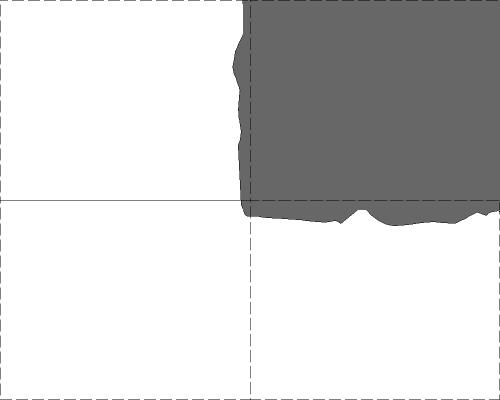
- Consider a region of terrain that is organized into quadrants, where the
upper-right quadrant consists of ocean, and the other three quadrants
consist of the terrain bordering the ocean. The ocean quadrant is not
represented in the producer's system. The region is represented in SEDRIS
by a Quad Tree Related Features
with 3 component Union of Features.
(Since the remaining quadrant had no Features, it
was not represented.)
FAQs
- If a Quad Tree Related
Features has less than 4 components, why is the data being organized
under a Quad Tree Related Features
at all?
- A Quad Tree Related Features is
used when an object in the hierarchy contains spatial components that
occupy a certain quadrant. These quadrants might not contain
Primitive Features, which is why this
class can have less than four components.
- Where is the Spatial Domain component?
- Quad Tree Related Features
automatically has a Spatial Domain component,
because it is a Feature. Unlike
Features in general, however,
Quad Tree Related Features has a
business rule stating that the Spatial Domain
component is mandatory.
Constraints
Associated by (one-way)(inherited)
Associated with (two-way)(inherited)
Composed of (one-way)(inherited)
- optionally, some {ordered} Attribute Set Indices
- optionally, a Classification Data
- optionally, some Colors
- optionally, some {ordered} Image Mapping Functions (notes)
- optionally, some Labels
- optionally, some Property Tables
- optionally, some Property Table References
- optionally, some Property Values
- optionally, a Rendering Priority Level
- optionally, a Spatial Domain
- optionally, a Reference Surface
- optionally, some Sound Instances
- optionally, some Property Descriptions
Composed of (two-way)(inherited)
Composed of (two-way)
Composed of (one-way metadata)(inherited)
Component of (two-way)(inherited)
- optionally, some Union of Features
- optionally, some Alternate Hierarchy Related Features through Feature Hierarchy Data
- optionally, some Classification Related Features through Feature Classification Data
- optionally, an Environment Root
- optionally, a Feature Model
- optionally, some Time Related Features through Feature Time Constraints Data
- optionally, some Level of Detail Related Features through Feature Level of Detail Data
- optionally, some Oct Tree Related Features through Feature Oct Tree Data
- optionally, some Perimeter Related Features through Feature Perimeter Data
- optionally, some Quad Tree Related Features through Feature Quad Tree Data
- optionally, some Spatial Index Related Features through Feature Spatial Index Data
- optionally, some State Related Features through Feature State Data
Notes
Composed of Notes
 Added to support "attributes for derived objects."
 That is, these components are used only to specify
 texture mapping information for geometry that
 is derived from the <Feature> by the consumer.
 These <Image Mapping Functions> must use
 <Image Anchor> components to specify the mapping.
Fields Notes
 If true, then for any object that exists 'below' this aggregation,
 each object will appear in only one 'branch' of this aggregation.
 If false, then objects may appear in multiple 'branches' of this
 aggregation.
 If true, then each 'branch' from this aggregation is its own,
 independent topology.  If false, then all of the branches exist
 within the same topology.
 If true, then each 'branch' strictly follows the rules of this
 aggregation.  If false, then each 'branch' might bend the rules a bit.
 For example, if this is a spatial aggregation, than a value of true
 indicates that objects will *not* cross the spatial extents defined
 by this aggregation relationship, and a value of false indicates
 that objects might cross those bounds.  For another example, if this
 is a time-based aggregation, then a value of true indicates that all
 branches will only contain data valid for the times specified for
 each branch, and a value of false indicates that the branches have
 the option of including data that falls outside of the specified
 time ranges for that branch.
Prev: Pyramid Directional Light.
Next: Quad Tree Related Geometry.
Up:Index.