Class Name: Time Related Geometry

Superclass - Aggregate Geometry

Definition

An aggregation of Geometry Hierarchies that are differentiated by the Geometry Time Constraints Data link objects attached to the aggregation relationships used to reach the Geometry Hierarchy objects.

Primary Page in DRM Diagram:

Example

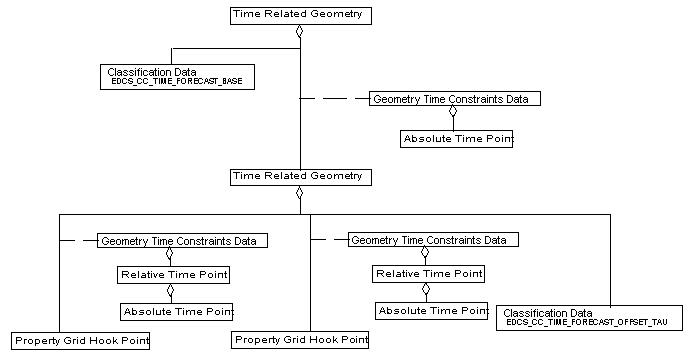
  1. Atmospheric forecast data is organized using nested Time Related Geometries.

    Time Related Geometry, Example 1

    The Classification Data define what each Time Related Geometry corresponds to. The outer Time Related Geometry corresponds to base forecast times, while the inner Time Related Geometry corresponds to forecast taus.

    In the forecast world, models are run starting at some base starting time, e.g., at 0Z and 12Z. The model then produces forecasts at several deltas after the base starting time, e.g. at 6, 12 ,18, and 24 hours. These are known as forecast taus.

    Consequently, if you run forecast models at 0Z and 12Z, and each produces a 24 hour forecast, you get the following overlap.

     16 Nov                 17 Nov                     18 Nov
     0Z   +6    +12   +18   +24
                12Z   +6   +12    +18    +24
                            0Z    +6     +12    +18    +24
                                   etc.
    

    So to uniquely identify a forecast, you must specify the base forecast time and the delta (tau). This is why nested Time Related Geometry has been used in this example; one Time Related Geometry defines the base forecast time, while its component Time Related Geometry defines the forecast tau.

    Note that this approach is needed only if multiple forecasts with overlapping forecasts are included in the transmittal. If we just use the analysis (0Z) and +6 forecasts from each forecast, then we would have

     16 Nov             17 Nov
     0Z   +6  12Z  +6   0Z   +6   12Z   +6  etc
    

FAQs

--FAQs needed here --

Constraints

Associated by (one-way)(inherited)

Associated with (two-way)(inherited)

Composed of (one-way)(inherited)

Composed of (two-way)(inherited)

Composed of (two-way)

Composed of (one-way metadata)(inherited)

Component of (two-way)(inherited)

Inherited Field Elements

SE_BOOLEAN unique_descendants; (notes)
SE_BOOLEAN independent_topologies; (notes)
SE_BOOLEAN strict_organizing_principle; (notes)

Field Elements

SE_TIME_DATA_TYPE_ENUM time_data_type;

Notes

Fields Notes

unique_descendants

 If SE_TRUE, then for any object that exists 'below' this aggregation,
 each object will appear in only one 'branch' of this aggregation.
 If SE_FALSE, then objects may appear in multiple 'branches' of this
 aggregation.

independent_topologies

 If SE_TRUE, then each 'branch' from this aggregation is its own,
 independent topology.  If SE_FALSE, then all of the branches exist
 within the same topology.

strict_organizing_principle

 If true, then each 'branch' strictly follows the rules of this
 aggregation.  If false, then each 'branch' might bend the rules a bit.
 For example, if this is a spatial aggregation, than a value of true
 indicates that objects will *not* cross the spatial extents defined
 by this aggregation relationship, and a value of false indicates
 that objects might cross those bounds.  For another example, if this
 is a time-based aggregation, then a value of true indicates that all
 branches will only contain data valid for the times specified for
 each branch, and a value of false indicates that the branches have
 the option of including data that falls outside of the specified
 time ranges for that branch.

Prev: Time Related Features. Next: Time of Day. Up:Index.